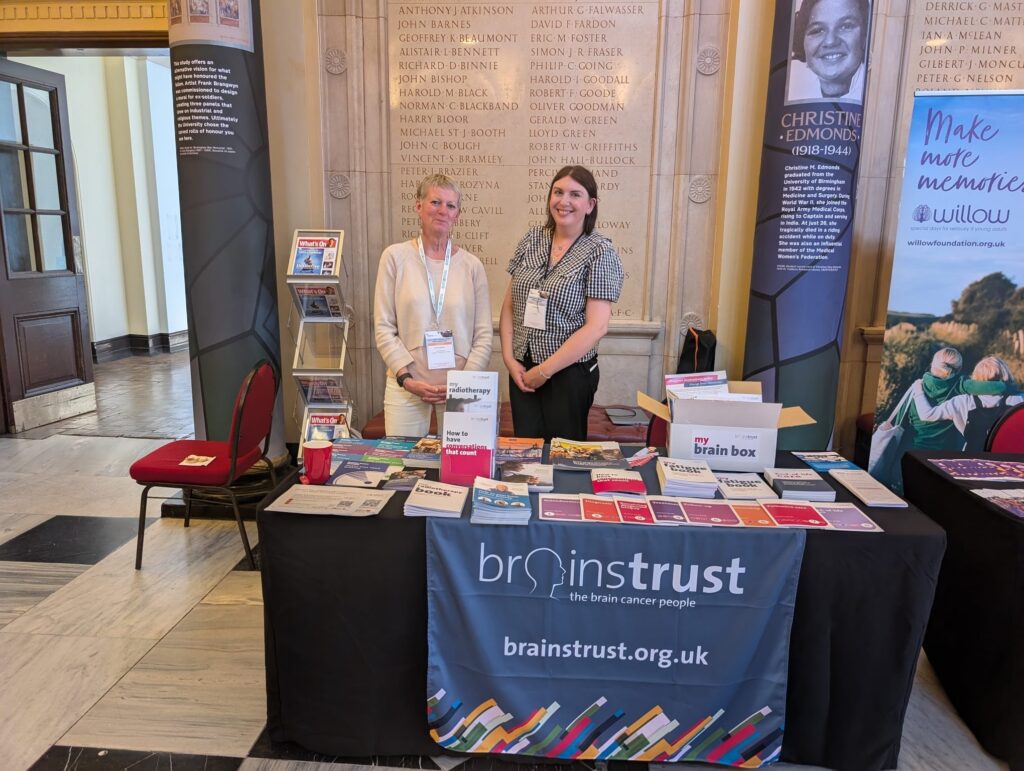
Dr Helen Bulbeck, Director of Services and Policy at brainstrust, shares her reflections from the first day of BNOS 2026 in Birmingham.
BNOS 2026 – the congress for UK neuro-oncology, taking place from 1st–3rd July 2026 at the University of Birmingham. This year’s theme, “Local Therapies for Brain Cancer” highlights progress at the crossroads of neuro-oncology, biology, and technology – advances that are transforming treatment approaches and offering new hope for patients.
BNOS is the British Neuro-Oncology Society, you can read more about the Society here: https://www.bnos.org.uk/
Day 1 recap – Research built by people living with a brain tumour
Today we heard about seven trials with one thread. Patient voice ran through every study outlined here. And through brainstrust’s Patient Research Involvement MovEment (PRIME), brainstrust and PRIME volunteer research advocates are a co-applicant on each; not consulted after the fact, but in the DNA of the science from designing the question and building the trial. That’s what patient and public involvement is supposed to look like: not a box ticked, but a seat at the table from day one.
None of this happens without the brain tumour community. Every question you’ve helped us shape, every protocol you’ve challenged, every honest conversation about what actually matters is reflected in these trials. They would not be open today if your voices hadn’t played a key part in getting them there.
Thank you.
Here are the studies that were shared:
Epic – GB
Who it’s for: Adults with recurrent glioblastoma.
What it does: A window-of-opportunity platform trial giving people a short course of an
investigational drug before surgery, then studying the removed tumour tissue to see whether
the drug actually reached and acted on it so people can carry on with a promising treatment,
or stop early and try something else, based on real evidence rather than guesswork.
Led by: Sheffield (Mr Ola Rominiyi) and Glasgow (Professor Anthony Chalmers), funded by Yorkshire Cancer Research, delivered across Sheffield, Leeds, Hull, Edinburgh, Manchester and Nottingham.
ACT – BT
Who it’s for: Adults with any primary brain tumour, anywhere in the UK.
What it does: Not a treatment trial, but a UK-wide referral panel of ten leading trial experts who meet weekly to match patients with any suitable open study, tackling the fact that brain tumour trials have some of the lowest recruitment rates of any cancer, and that access depends too heavily on where you live.
Hosted by: The University of Leeds, led by Professor Susan Short, funded by The Brain Tumour Charity.
PORTRAIT
Who it’s for: Adults newly diagnosed with glioblastoma.
What it does: The first trial in the world to test starting Tumour Treating Fields (TTFields) therapy before surgery and radiotherapy, rather than after as standard practice, asking whether treating the tumour earlier can slow its growth before it has the chance to gain momentum.
Led by: Dr Gerben Borst at The Christie NHS Foundation Trust, Manchester.
COMBAT-GB
Who it’s for: Adults with newly diagnosed glioblastoma.
What it does: A phase I safety trial combining an immunotherapy drug (nivolumab) with an “enhancer” drug (decitabine/cedazuridine) to find a safe dose and see whether the combination can boost the immune response against glioblastoma, where immunotherapy alone has had limited effect.
Led by: Professor Puneet Plaha at Oxford, funded by Cancer Research UK.
RECURRENT-GB
Who it’s for: Adults whose glioblastoma has returned after standard treatment.
What it does: A national randomised trial asking a question clinicians have long faced without a clear answer – does repeat (‘re-resection’) surgery improve quality of life and outcomes, compared with non-surgical management?
Led by: Professor Puneet Plaha through an Oxford-coordinated, NIHR-funded, UK multicentre trial.
APPROACH
Who it’s for: Adults with oligodendroglioma, a slower-growing form of glioma.
What it does: A phase III trial comparing standard radiotherapy with proton beam therapy, aiming to reduce the long-term side effects of treatment for people who can expect to live with the after-effects for many years.
Led by: Dr Louise Murray, University of Leeds.
LEGATO
Who it’s for: Adults with recurrent glioblastoma at first progression.
What it does: a European phase III trial testing whether adding radiotherapy to standard lomustine chemotherapy improves survival, compared with chemotherapy alone — there is currently no agreed standard of care at this point in the disease.
Coordinated by: EORTC-coordinated, 43 sites across 11 countries; brainstrust is a formal consortium partner alongside EORTC, the Medical University of Vienna, Sapienza University of Rome and the Syreon Research Institute.
Beyond these trials, brainstrust has contributed to a number of abstracts at BNOS 2026, spanning real-world data on brain tumour outcomes, radiotherapy peer review, a national survivorship study, and the introduction of patient-reported outcome measures into routine clinical care.
Each reflects the same underlying principle:
The patient voice belongs in the evidence base, not alongside it.
PRIME is possible because of the support of Brain Tumour Research and funding from the studies it supports.
New research Strategy for Brain Tumour Research
Day one also saw Brain Tumour Research launch its new research strategy. the focus remains on supporting a networked group of centres of excellence, and has sharp focus on three priorities:
- Growing research capacity and infrastructure
- Advancing knowledge and delivering breakthroughs
- Accelerating treatment development
You can read more here: https://cdn.shopify.com/s/files/1/0615/3122/6285/files/Brain_Tumour_Research_-Research_Strategy_Report-D6_ISSUU.pdf?v=1782469692
Find out more
Find out more about PRIME and how you can get involved: https://brainstrust.org.uk/about-brainstrust/prime/