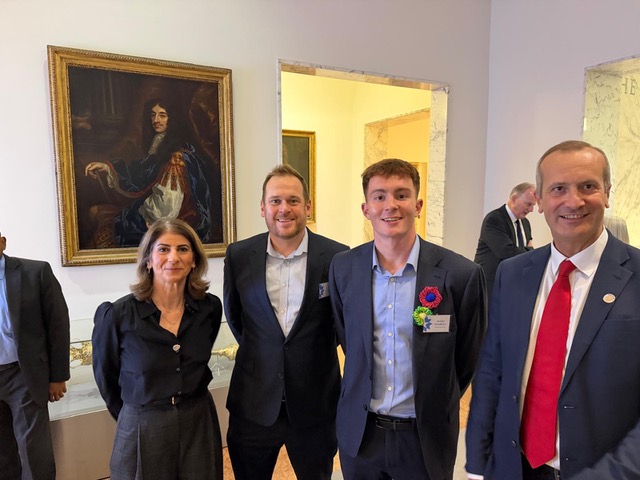
Pictured left to right: Michele Afif, CEO, The Brain Tumour Charity; Will Jones, CEO, brainstrust; Archie Goodburn; Dan Knowles, CEO,Brain Tumour Research.
Today belongs to Archie Goodburn.
Archie is a 25-year-old swimmer living with inoperable brain cancer. Over the past year he has done something that takes great courage: speaking openly, in public and on national television, about what it means to live with a brain tumour. He asked why trials running elsewhere in the world are not reaching patients in the UK. He called that unfair and unjust, and he asked the Prime Minister to act.
Today the Prime Minister and Health Secretary met Archie in Downing Street and set out a package of commitments to give people with brain cancer a faster route from research to treatment:
- An immediate expert review. Professor Anthony Chalmers, Chair of the Brain Tumour Group within the UK Collaborative for Cancer Clinical Research (UK3CR), will lead a review reporting within three months. Leading experts will assess what has changed for patients since the 2018 government review, and what is still holding progress back.
- A national action plan. The review’s findings will shape a plan to get new treatments out of the lab and to patients faster.
- A new national brain cancer clinical lead. The Department of Health and Social Care will appoint a dedicated lead to drive this work forward.
- Faster decisions on rare cancer medicines. The Prime Minister has asked the MHRA to complete its review of the rules for orphan drugs, which treat rare conditions, in two years rather than three, so patients could get promising new treatments sooner.
- A drive to get more people onto clinical trials. Patients, families and charities will help design it. The Health Secretary will host a round table with researchers, clinicians and charities to find new ways to boost participation.
- Making the UK a leader in brain cancer research. Ministers will work with researchers and industry to make the UK a better place to run clinical trials. Next year, DHSC will partner with Cancer Research UK to bring together global experts in brain cancer research.
These commitments came about because Archie was brave enough to tell his story, and determined enough to keep telling it. We are hugely grateful to him.
Unprecedented attention, at the highest level
Brain tumours have never had this level of interest from the top of government. The brain tumour community has been heard in Downing Street and at the Department of Health and Social Care. Its asks have been taken seriously and met with real commitments.
Prime Minister Andy Burnham said:
“Archie is an inspiration to us all, and I am determined to deliver the change patients and their families deserve.
“He has spoken passionately about the need for change on brain cancer, and he’s right: progress hasn’t been good enough, here or anywhere else. Families facing this disease can’t afford to wait.
“That is why today we’re committing to appoint a dedicated national lead and setting out how we’ll get new treatments to patients faster. I strongly support this work and was delighted to welcome Archie to Downing Street to discuss it with him in person.”
This moment did not happen by chance. It is the culmination of decades of work by patients, families, clinicians, researchers and charities. Many of them campaigned through years when brain tumours received a tiny share of national cancer research funding and little political attention. Many of the people who started that work are no longer here to see this day. We remember them, too.
Today’s announcement is a culmination, but it is also a beginning.
How it fits together
Today’s package does not stand alone. It builds on two other major steps:
- The National Cancer Plan for England, which for the first time gives rare and less common cancers their own focus and commits to standardising brain cancer care across the country.
- The Rare Cancers Act, which puts rarer cancers, including brain tumours, firmly on the national agenda.
Each matters on its own. Together they give the brain tumour community something it has never had before: a joined-up framework for improving care now and research for the future.
What brainstrust says
Will Jones, Chief Executive of brainstrust, said:
“This is a landmark day for everyone affected by a brain tumour. Today’s steps – an expert review, a national action plan, a national clinical lead and a faster route from lab to patient – show what happens when a community speaks with one voice and government listens.
Congratulations to Archie Goodburn, whose bravery and tenacity helped bring about this moment, and to the brain tumour charities for a joined-up effort. We thank the Prime Minister and Health Secretary for responding positively.
We welcome the commitment to put patients and families at the heart of the drive on clinical trials. Alongside improving people’s experience now, this keeps research relevant to those diagnosed tomorrow. brainstrust looks forward to helping make it real.”
A shared statement from the brain tumour community
brainstrust, Brain Tumour Research, Brain Tumour Support, The Brain Tumour Charity and The Tessa Jowell Foundation, along with The Tessa Jowell Brain Cancer Mission, said:
“On behalf of brain tumour patients and their families, both today and in the future, we would like to thank Archie for his determination and to Government for listening to the voices of the community and recognising the urgent need for change.
“We applaud the commitment from the Prime Minister today, which will give a platform for significant improvements in the months and years ahead.
“We collectively remain committed to building on the momentum that has grown over the last year and to working with Government to ensure these welcome initiatives deliver meaningful change for patients and their families.”
Twenty years in the making
Few people have watched this moment come together more closely than Helen Bulbeck. Helen co-founded brainstrust after her daughter was diagnosed with a brain tumour in 2006. Back then, families faced a diagnosis with very little information, support or hope to hold on to. In the twenty years since, Helen has worked alongside patients, clinicians, researchers and policymakers to change that.
Helen Bulbeck, co-founder and Director of Services and Policy at brainstrust, said:
“When my daughter was diagnosed in 2006, it felt as though nobody was paying attention to brain tumours. We set up brainstrust because families deserved better. They deserved to be heard, to be supported and to be given a reason to hope. Today, the brain tumour community has been heard at the very highest level, and that means a great deal to me.
“No single announcement will transform things on its own. Progress will come from the sum of the parts. The National Cancer Plan, the Rare Cancers Act and today’s package each matter, but together they give us a real foundation to build on. For the first time, we can reasonably hope for better support and better care today, and better treatments and better outcomes tomorrow.
“This has been a long road, travelled by many people, some of whom are no longer with us. I hope they would be proud of where it has brought us. Now the work is to make sure every one of these commitments reaches the people who need it.”
Today and tomorrow
As Helen says, it is the combination of commitments that will drive progress. People living with a brain tumour today need better support and fairer care now, and research will shape what happens to those diagnosed tomorrow. Both matter, and they belong together.
For people living with a brain tumour today, the National Cancer Plan for England sets out commitments that can make a real difference soon:
- Standardised care across the country. A new National Lead for Rare and Less Common Cancers, working with specialist leads, will oversee the national standardisation of care, including brain cancer care. The quality of treatment should depend on what a patient needs, not where they live.
- Specialist expertise for everyone. More patients with rarer cancers will have their care reviewed and treated by specialist teams at specialist centres, even if they are diagnosed in a rural area.
- Genomic testing offered to every patient who could benefit.
- Clinical trials searchable through the NHS App, with Be Part of Research built in, so finding a trial does not depend on knowing who to ask.
- Prehabilitation embedded in care, so people are better prepared, physically and mentally, before treatment.
For those who will be diagnosed tomorrow, today’s package means a clear plan to move new treatments from the lab to patients faster, quicker decisions on rare cancer medicines, and more opportunities to take part in research. The National Institute for Health and Care Research already supports 59 brain tumour studies across the country, including 35 clinical trials. Getting more people onto those trials, with patients and families helping to shape how, is one of the most important things we can do now for the future.
What happens next
brainstrust will take part fully in the work ahead, including the expert review and the Health Secretary’s round table. We will make sure the experience of patients and families across England, Wales and Scotland is heard at every stage. We will keep pressing for commitments to turn into changes people can see and feel: in clinics, at diagnosis, and in the months and years of living with a brain tumour.
To Archie, and to everyone who has shared their story so that others might fare better: thank you. Today is yours.
If you or someone you love has been affected by a brain tumour, brainstrust is here to help.