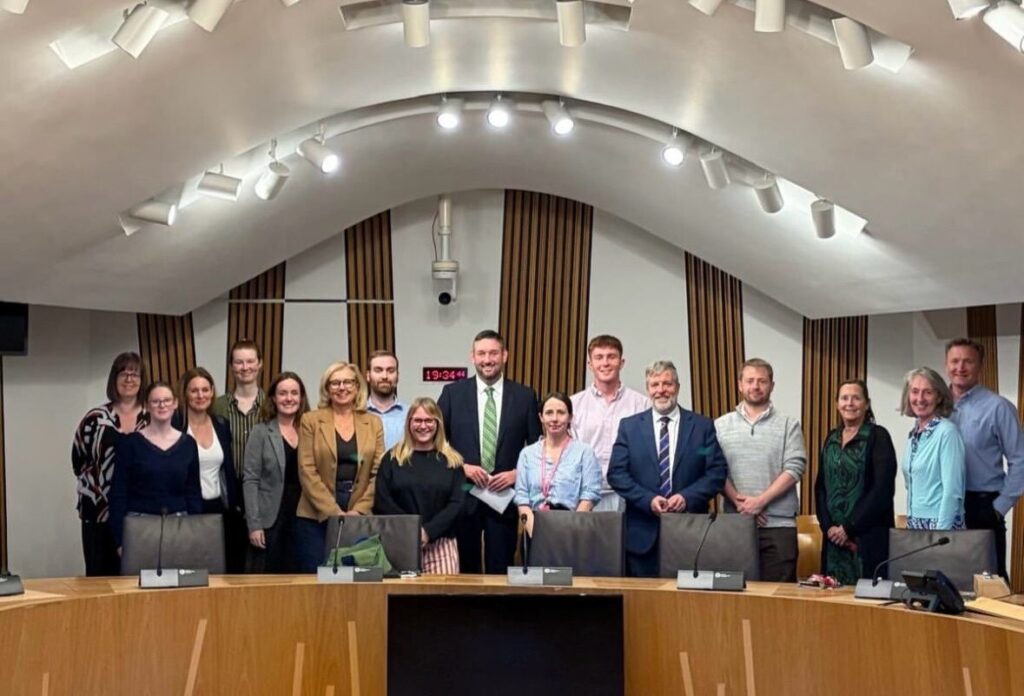
brainstrust recently joined the first meeting to reconvene the Scottish Cross-Party Group (CPG) on Brain Tumours at Holyrood. The meeting brought together people affected by brain tumours, campaigners, MSPs and charities, including brainstrust and The Brain Tumour Charity, with Brain Tumour Research providing the Secretariat. Bringing those perspectives together gives us an opportunity to look clearly at where progress is being made in Scotland, where gaps remain, and what needs to change.
Around 73% of brain tumour diagnoses in Scotland happen following an emergency presentation – the highest proportion of any cancer type. Previous discussions within the CPG have also highlighted barriers to genomic testing, clinical trials and newer treatments, including examples where people in Scotland have not been able to access trials available elsewhere in the UK.
At brainstrust, we see these issues from both sides. We support people as they navigate diagnosis, treatment and what comes next, so we hear where systems are difficult to navigate, where information is missing and where options narrow. Through PRIME, we work upstream too- bringing people affected by brain tumours into research early enough to influence the questions being asked, how trials are designed and how research is carried out.
That matters because access to research is about more than whether a trial is technically open in Scotland. It is also about whether people know about it, whether eligibility criteria reflect the population who might benefit, whether taking part is practically possible, and whether research has been designed around the realities of life with a brain tumour.
These are connected problems. Diagnosis, access to testing, research participation, treatment and support cannot be improved in isolation from one another. Spaces like the CPG give us an opportunity to connect those conversations and identify where policy, research and practice are not keeping pace with what people need.
This first meeting was mainly about getting the group up and running again for the new parliamentary term. Once the formal meeting had closed, many of us stayed to continue the conversation – looking at some of the issues affecting people in Scotland and where charities, campaigners and policymakers could work more closely together.
Archie Goodburn was among those contributing, bringing his experience of campaigning around access to treatment in Scotland. It was a useful reminder that inequalities in access aren’t theoretical. They become very real when the research or treatment that could matter to you exists, but the system around it puts it out of reach.
For brainstrust, Scotland is also part of a wider picture. We support people and work with researchers across the UK, which gives us a view across the different systems in Scotland, England, Wales and Northern Ireland. Health is devolved, and solutions need to respond to each nation’s context. But research does not respect those same boundaries: trials, research teams, evidence and new treatments routinely cross them.
We think there is an important opportunity here. Progress in one nation should create learning for the others, rather than greater inequality between them. And as brain tumour research develops, we need to pay as much attention to who can access that progress as we do to the progress itself.
For us, that is what equity looks like: not simply creating more research and more options but making sure they reach the people they are intended for, wherever they live.