I want to live well with a meningioma

Living well with a meningioma

Being diagnosed with a meningioma can often signal a whirlwind of medical appointments, scans and treatment plans, usually at a time when your life is in turmoil. At some point, things will start to slow down. You may have finished your current course of treatment, or if you are on active surveillance, the time between your scans may have decreased. It is at this point that you may find yourself thinking, ‘What is next?’ At brainstrust we believe living with a meningioma should mean living your best day, every day. In this section, we will talk about what support should be available to you, how you can get it and some strategies to support this.

Your treatment plan and pathway will be individual to you, but the feeling of wanting to know what support you can have to help with your quality of life is something that many people will experience. See this support as an entitlement.

You will also find some practical information about reapplying for your driving licence, travel options and finances and benefits support.

Follow-up support

Some time may have passed following your diagnosis, and while you no longer find yourself in the shock of new, you may still find yourself needing a little extra support to help you live the life you want. Sometimes, knowing what you can expect in terms of follow-up care can help you to feel better prepared and more in control.

What is follow-up care?

Follow-up care is the transition from your initial diagnosis and treatment plan to living with your diagnosis for the longer term, when you may not have such close contact with your clinical team. It can feel a little like you have been cast adrift. It’s okay to feel like this. Your treatment plan may have included surgery, radiotherapy or chemotherapy, or you could be on active surveillance. Whatever treatment you have, it is important to know what is next.

The optimum standard of care according to the NICE Improving Outcomes Guidance for the follow-up phase of care includes:

Ready access to specialist neuropsychology and neuropsychiatry services

Regular clinical reviews to assess changes in your physical, psychological and cognitive well-being

Ready access to assessment and rehabilitation services for problems such as epilepsy, headaches, and speech or visual problems

Routine imaging

Immediate access to specialist equipment that would assist rehabilitation as necessary

Clear information on who to contact and how if you are concerned about your condition

Follow-up as close to home as possible

The above is the minimum level of care that you should expect at this stage. However, sometimes, for a variety of reasons, our healthcare service may not be able to meet these standards. These standards of care have been taken from our ‘Follow-up’ patient guide. Our patient guides are a brilliant resource designed to help guide you through the patient pathway and know what your options are.

How can I access the support I need?

Hospitals often have different services that they are able to provide, and different means of being able to provide them. For things such as routine imaging and clinical reviews, these will be organised by your clinical team at intervals agreed by them, and hopefully in discussion with you, based on your diagnosis and condition.

For some of the other services detailed above, these may include referrals to other departments or services.

Here are some tips to ensure you have clarity on what support you can get:

Ask questions. This may sound simple enough, but often in a medical appointment, you are there for a specific reason, such as finding out the result of your surgery or latest treatment, and it can be difficult to think of what questions to ask about follow-up care. Feel prepared by sitting down for a few minutes the day before your appointment and writing down the questions you want to ask.

Keep a record of your symptoms and things that you feel you need support with. Our ‘Who’s who in your clinical team’ guide can help to give you an overview of who in your team might be able to help.

Speak to brainstrust. While we won’t be able to give you medical advice, we can help to elicit the questions that you want to ask. We can also signpost you to who can help and provide you with information and resources so that you feel more in control and involved in your clinical care.

How can brainstrust help?

  • We can use our coaching models to help you focus on what matters to you the most at the moment and achieve clarity.
  • We can signpost you to the right information and resources to help you make informed choices and decisions, and point you in the right direction.
  • We run webinars and workshops on topics that are important to you when you are living with a brain tumour diagnosis.

Driving and Travel Assistance

Driving is a topic that is frequently spoken about among our community. When you are diagnosed with a brain tumour of any type, and you hold a valid driving licence, you must inform the DVLA of this. Once you let them know, they will then assess whether you have to surrender your driving licence. This decision is based on many different things, including the tumour type and your treatment pathway.

Our ‘Driving’ Know How goes into more detail about the process of contacting the DVLA and how long you may have to surrender your licence for.

We know that the prospect of having to surrender your driving licence is a big challenge. It can mean a loss of independence, and the uncertainty of when you may be able to resume driving can cause feelings of anxiety. Below, you will find some information on some alternative travel options while you are not able to drive.

If you are struggling with symptoms caused by a meningioma, you may be entitled to help with some aspects of travel and getting around. In some cases, this may help to make day-to-day living a little easier.

While a meningioma diagnosis doesn’t give you an automatic entitlement to any of the schemes outlined here, it is always worth looking into your eligibility according to your symptom burden.  Most of the items listed below require you to prove eligibility for certain disability benefits.

National Rail offers a Disabled Person’s Railcard scheme, where you and one person accompanying you can get a third off rail fares. This costs £20 and is available here.

You can link your Disabled Person’s Railcard to your Oyster card to get a third off Oyster pay-as-you-go single fares and daily caps on National Rail, London Underground and Docklands Light Railway services. Register at any London Underground, Overground or National Rail station ticket office that issues Oyster cards.
If you live in a London borough, you can apply for a Disabled Person’s Freedom Pass to gain free travel across London and free bus journeys nationally. Some boroughs offer passes at their discretion to people who do not meet the eligibility criteria.

Contact your local county council to apply for a free bus pass.

what3words is a free app that helps you to easily and accurately identify your location to the emergency services. This could potentially be very useful if you have seizures and going out alone is a worry for you. Search ‘what3words’ in your phone’s app store.

Displaying a Blue Badge allows you to park in disabled parking bays, often meaning that you can park closer to your destination.

You may be eligible for a Blue Badge if you cannot walk or have difficulty walking, and can evidence this in your application.

Additionally, the criteria have recently been expanded so that people with ‘invisible’ disabilities are now potentially eligible for the scheme. This means that in addition to physical disabilities, non-physical disabilities, including cognitive impairment, psychological effects, such as feeling overwhelmed by busy or loud environments, and cognitive fatigue, are now taken into account.

Check your eligibility and apply here (England, Wales & Scotland) or here (Northern Ireland).

If treatment can give you an unpredictable stomach, or if you suffer from sickness, it can make the thought of going out anywhere new really challenging. A RADAR key offers you access to the 10,000 locked disabled toilets in the UK, making going out in public far less worrying.

More information about the RADAR National Key Scheme and accessible toilets is available here.

Support around Finances and Returning to Work

Following your diagnosis, circumstances may change, and you might find yourself in a situation where your finances are impacted and you are having to look at what financial support is available to you.

If you would like to speak to someone about benefits that you may be eligible to apply for, then we can connect you with our Welfare and Benefits Advisor volunteer. Send us an email on hello@brainstrust.org.uk or call us on 01983 292 405 to find out more.

Our ‘Finances and benefits’ Know How guides you through the different types of benefits that may be available to people living with a brain tumour diagnosis. It also signposts where you can go to for support.

Returning to work following treatment for a meningioma can be a big change. You may be returning to the same job that you were doing before your diagnosis, or you could find that you are looking for a change. Either way, we know this can feel like a daunting task, and one that you may find you need support with.

Our ‘Returning to work’ Know How will guide you through some strategies to help you prepare for returning to work. It will also advise you on support and help that may be available to you.

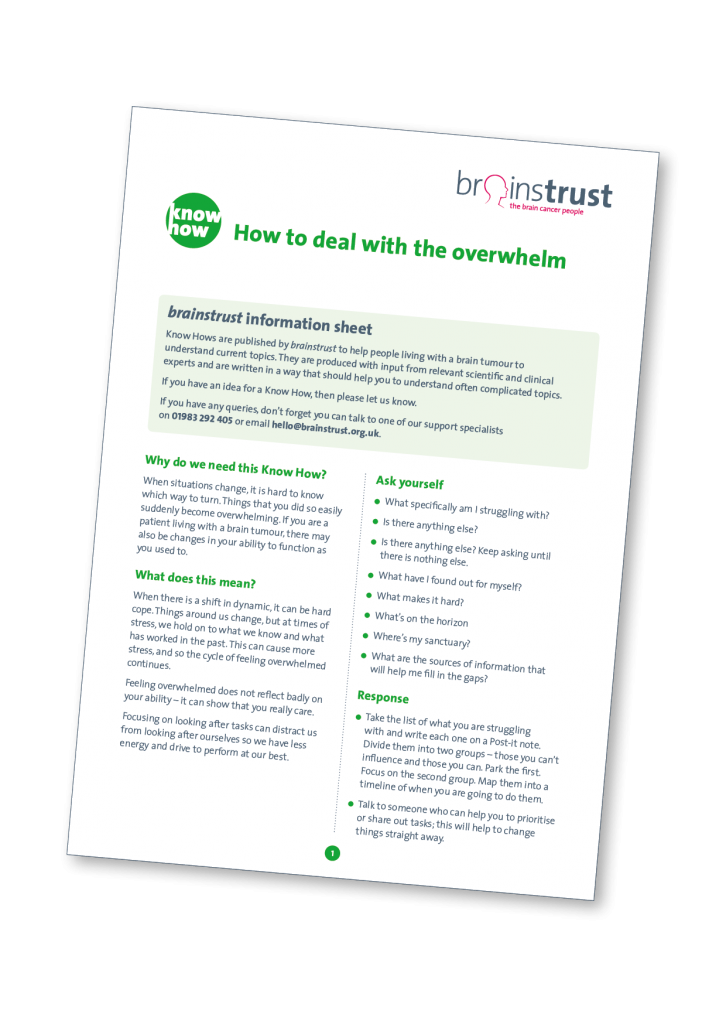
When dealing with financial challenges, it can be helpful to have some strategies available to you to help you take a step back and feel able to deal with them.

Our ‘How to deal with money worries’ Know How is designed to provide you with some strategies and tips to help you look at financial challenges differently and work through them.

Subscribe to our mailing list to hear about all the latest news, events, research and resources

Fields marked with an * are required